Claude watermark status
Does Claude watermark text?
Yes, for supported models. Anthropic says supported Claude models embed an imperceptible, model-level watermark in generated text. Coverage is not identical across every model, and the public third-party detection mechanism has not yet been documented.
What Anthropic currently says
Anthropic's guidance says models launched on or after August 2, 2026 support marking at launch, while support for earlier models is still being added. The marking applies to supported-model output across Claude, the API, Claude Code, Claude Cowork, and Claude Tag.
Two details in that sentence do a lot of work. First, “supported models” is not the same as “all Claude” — an older model answering a prompt today may produce output with no mark at all. Second, the mark is described as model-level and imperceptible: it is a property of how the text was generated, not a character sitting in the string that you could open a hex editor and find.
Anthropic has also said that a general third-party detection method is still to come. Until that exists, nobody outside Anthropic — including this site — can tell you whether a specific paragraph carries the official Claude text watermark.
Coverage is per model and per surface
When people ask “does Claude leave watermarks in text” they usually want a yes or no. The accurate answer has three dimensions:
- Which model produced it. Marking arrived with newer models. Output from an older model, or from a model that has not had support added yet, may carry nothing.
- Which surface it came through. Anthropic lists Claude, the API, Claude Code, Claude Cowork, and Claude Tag. Output routed through some third-party wrapper is a different question.
- What happened to the text afterwards. Heavy editing, translation, summarising, or quoting a single sentence all change the text that a detector would have to work with.
So the honest form of the answer is: yes for supported models on supported surfaces, with detectability depending on what the text has been through since.
Invisible watermark versus visible text residue
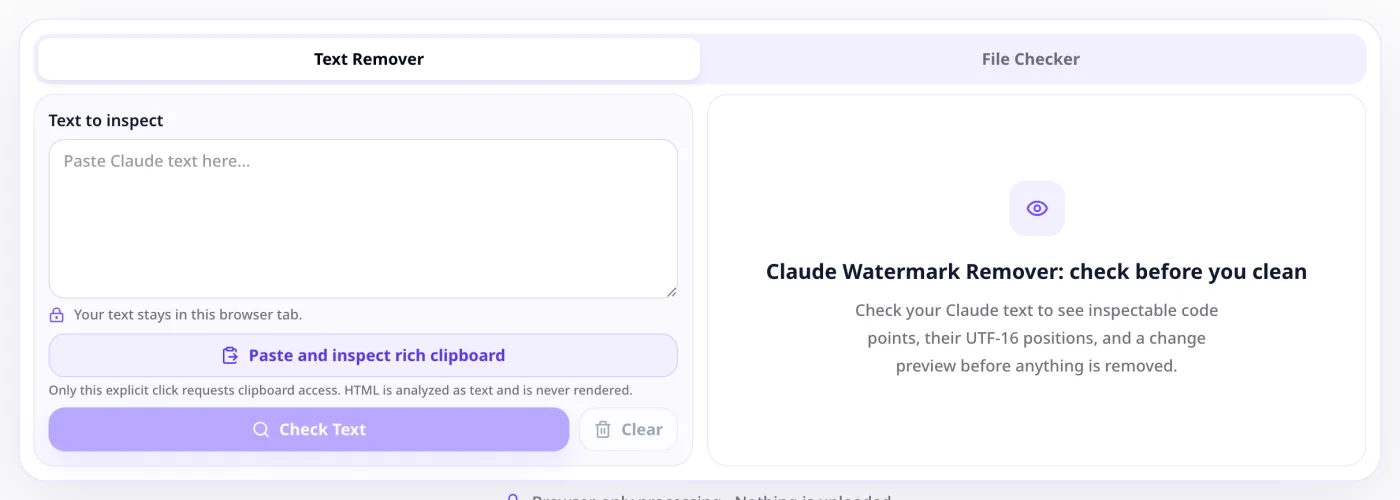
A model-level watermark and an invisible Unicode character are not automatically the same thing. Copied text may contain zero-width characters, bidirectional controls, or rich clipboard formatting for ordinary technical reasons. Our text tool reports only those directly observable artifacts.
This distinction matters because a lot of advice online conflates the two. Somebody finds a zero-width space in text they copied out of Claude, concludes it is “the Claude watermark”, and writes a tutorial about removing it. The character is real. The conclusion is not supported. Zero-width spaces show up in text copied from web pages, word processors, chat clients, and CMS editors that have never been near an AI model.
What you can say with confidence is narrower and more useful: this text contains these specific characters at these specific positions, and here is what happens if you remove them. That is exactly the scope the Claude Watermark Remover operates in.
The same reasoning applies to every other assistant. If the text you are checking came from ChatGPT, Gemini, or Copilot, the AI text watermark remover runs the identical character-level inspection and sets out the same boundary for those providers.
What a negative check does not prove
Anthropic notes that lack of a detected mark does not establish that content was not AI-generated or processed. Earlier models, substantial edits, short passages, translations, and unsupported surfaces can all affect detectability.
Concretely, a clean result is compatible with all of the following:
- The text was written entirely by a person.
- The text came from a Claude model that does not yet carry marking.
- The text was Claude output that a person then rewrote heavily.
- The passage is too short to carry a statistical signal reliably.
- The text was translated out of its original language.
- The text came from an entirely different AI system with different provenance handling.
This is the single most misused result in the whole category. If you are an educator, editor, or reviewer, treat “nothing found” as the absence of evidence, never as evidence of absence. Making an accusation — or clearing someone — on the basis of a negative check is not something the current state of the technology supports.
What you can actually verify today
Three things are checkable right now with no special access:
- Hidden Unicode. Zero-width characters, word joiners, bidirectional controls, Unicode Tags, and selected control characters. Each one can be named, located, and shown in context.
- Clipboard formatting residue. When you copy rich text, an HTML layer travels alongside the plain text. That layer can carry inline styles, class names, comments, and office-suite markers.
- Signed file provenance. Supported image and media files may carry C2PA Content Credentials, which are cryptographically signed and genuinely verifiable — a different and much stronger kind of evidence than anything available for plain text.
Notice what is missing from that list: any way to read the model-level mark. That is not an oversight in the tooling. It is the current state of what has been made public.
 Verify this against Anthropic's source
How to use this in practice
If your goal is clean text — no stray invisible characters before you publish, commit, or hand something over — the character-level check is the right tool and it does the job completely. Paste, review each finding, remove what you choose.
If your goal is to determine authorship, no currently available public tool can do that for Claude text, and you should be sceptical of any product that claims otherwise. The most defensible position is to document what was inspected, what was found, and what remains unknown — which is the format this site reports in by design.