File provenance
Claude C2PA checker
Inspect Content Credentials in supported files, locally in your browser. Unlike text marking, signed file provenance is genuinely verifiable — a signature either validates or it does not. Anthropic attaches a signed credential to the files Claude generates and has said it will publish its own checker, but has not yet; until then any C2PA-aware reader can check one, and this is a C2PA-aware reader.
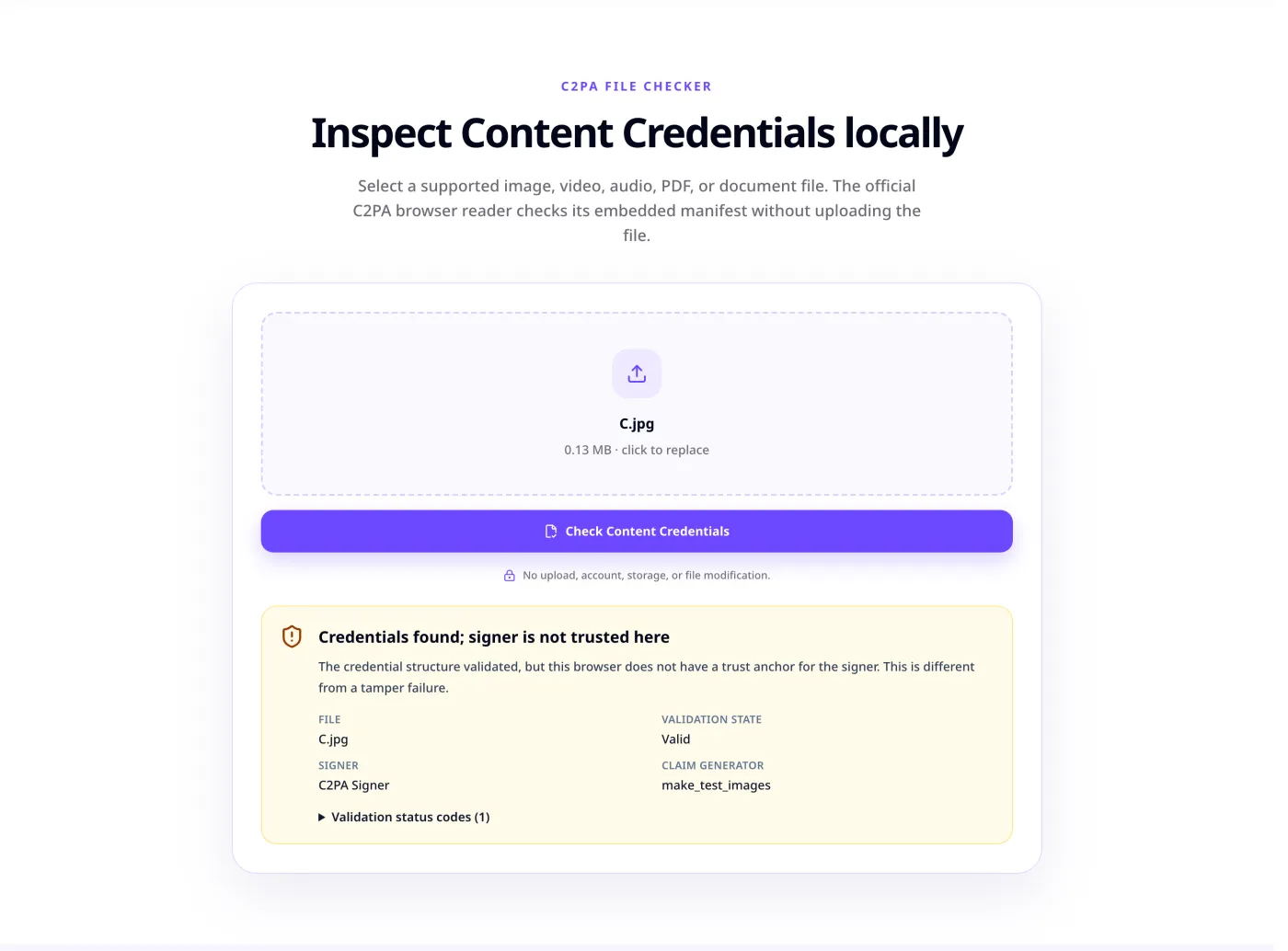
C2PA file checker
Inspect Content Credentials locally
Select a supported image, video, audio, PDF, or document file. The official C2PA browser reader checks its embedded manifest without uploading the file.
No upload, account, storage, or file modification.
What the Claude C2PA checker verifies
The checker uses the official open-source C2PA JavaScript reader to parse the file in this browser. It reports whether credentials are valid, signed by an untrusted identity, invalid, absent, or unsupported. The file is never sent to a ClaudeWatermarks server.
C2PA is an open standard for content provenance. A conforming tool can attach a signed manifest to a file recording what produced it and what was done to it. Because the manifest is signed and the content is hashed, later tampering is detectable rather than silent.
The five results and what each one means
Valid credential
A manifest is present, the signature verifies, and the hashes match the file as it stands. You can read the claim generator, the signer, the recorded actions, and the ingredient chain. This is the strongest evidence in the category — but it describes the file's history, not the merit or authorship of the ideas in it.
Untrusted or unknown issuer
The signature is intact but the signer is not on the trust list being used. This is not the same as forgery. It commonly means a smaller tool or a self-signed pipeline produced the credential. Read the signer identity and judge it yourself.
Invalid credential
A manifest exists but validation fails — the hashes no longer match, or the signature does not check out. Usually this means the file was edited after signing. Occasionally it means a processing step rewrote bytes without updating the manifest. Treat it as “the recorded history no longer matches this file”.
No credential
The overwhelmingly common case, and the most misread.
Unsupported file
The format cannot carry or be parsed for C2PA data in this browser build. No conclusion of any kind should be drawn.
No credential is not a negative authorship verdict
Content Credentials can be stripped during format conversion, re-saving, screenshots, or by using unsupported file types and platforms. A missing manifest does not prove a file was not created or processed by Claude or another AI system.
Ordinary things that remove credentials:
- Taking a screenshot of an image instead of saving it.
- Uploading through platforms that re-encode images on ingest.
- Exporting from an editor that writes a fresh file rather than preserving metadata.
- Converting between formats.
- Forwarding through chat apps that compress attachments.
Given how many everyday paths strip metadata, absence carries almost no information. Presence carries a lot.
How this differs from the text checker
The two tools on this site answer different questions with different levels of confidence. File provenance is cryptographic: it verifies or it does not. Text artifacts are observational: this character is present at this position, make of it what you will.
Neither one reads Anthropic's model-level text mark, and the Claude Watermark Remover does not strip signed credentials from files. Keeping the two apart is deliberate — conflating them is how misleading claims get made.
What is inside a manifest
When a credential validates, there is real detail to read rather than a single verdict:
- Claim generator. The software that produced the assertion.
- Signer identity. Who vouched for it, and whether that identity is on the trust list in use.
- Validation status. Whether the signature and hashes still check out against the file as it exists now.
- Recorded actions. What the tooling says was done — created, edited, converted, and so on.
- Ingredient chain. Which earlier assets this one was built from, each potentially carrying its own credential.
The checker reports the upstream library's status verbatim rather than inventing its own trusted or untrusted labels. Where a raw error code comes back, you see it alongside a plain-language explanation, so a surprising result can be looked up rather than taken on faith.
Everything stays in your browser
Parsing runs locally through the official open-source C2PA WebAssembly reader. The file is never uploaded, and there is no account, queue, or server-side copy. If your connection dropped after the page loaded, the check would still work.
That matters for the people most likely to need this. A journalist verifying a leaked image, a moderator reviewing a report, or a lawyer examining an exhibit should not have to hand the file to a third party in order to read its metadata.
Practical limits to keep in mind
- A credential describes a file's recorded history. It does not certify that the content is true, original, or good.
- Trust lists differ. An issuer unknown to one verifier may be recognised by another.
- Not every format can carry C2PA data, and support varies by build.
- Absence proves nothing at all, for the reasons listed above.
Used within those limits, a valid credential is the most solid provenance signal available today — considerably firmer than anything that can currently be established for plain text.